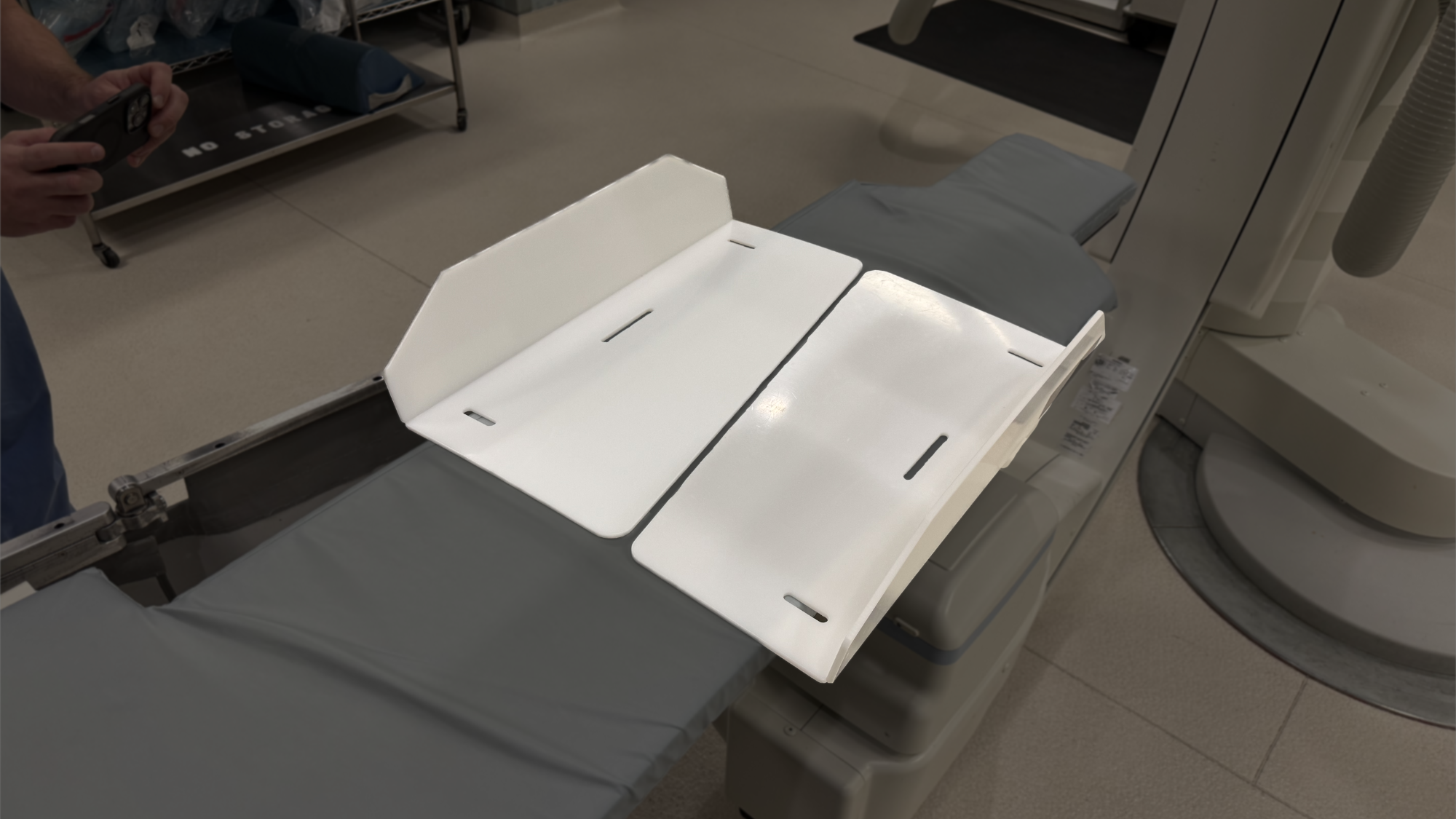
Take Five Minutes and Look at Your Lab Armboards
After years working in interventional radiology, we have seen a lot of armboards.
I have also seen a lot of armboards that probably should have been replaced years ago.
Cracked boards, chipped edges, and restraint slots that are beginning to fail are common. Many boards are also simply too short for today’s patients, leaving the hand or fingertips hanging unsupported beyond the end. On older boards, it is also not unusual to see layers of adhesive tape built up over time as staff try to cover damage or hold worn areas together.
Because armboards are such simple pieces of equipment, they are easy to overlook. They are not expensive, they do not have software updates, they do not generate images, and they rarely make it onto a capital equipment list. As a result, they tend to stay in service long after they should have been replaced.
That is why department leaders should take a closer look.
If you are a Director of Radiology, Cath Lab, Cardiac Services, Vascular Services, or an imaging department manager, take five minutes this week and physically inspect the armboards in your rooms.
Ask a few straightforward questions. Are the boards cracked or structurally compromised? Are the edges damaged or rough? Are restraint openings still reliable, or have they started to crack? Are the boards long enough to properly support the arms of the patients you treat today? Are staff improvising ways to secure the patient’s arms? Do technologists and nurses have to struggle to slide the board under a mattress or reposition a patient just to make it fit?
And perhaps most importantly, ask whether this is still the best level of support you want to provide for both patients and staff.
Armboards are easy to ignore because they are so familiar. They are used in every case, every day, and they rarely draw attention until something goes wrong. But patients do notice when their hand is hanging off the end of a board, and staff notice when they are fighting with equipment that should be simple to use. Over time, those small frustrations add up, and damaged equipment becomes part of the routine.
When we developed the Stratus Dovetail Armboard, we started with these kinds of observations. We asked whether the board could be longer, whether it could slide more easily beneath a mattress, whether restraints could have a more intentional attachment point, and whether there could be a proper place to grip the board during removal. We also looked at how a radiolucent armboard could better match the workflow of modern imaging rooms.
Those questions led to the Stratus Dovetail.
But whether you use ours or another design, the larger point remains the same.
Take another look at the armboards in your lab. They may be one of the simplest pieces of equipment in the room, but that does not mean they should be the most neglected.
Written by a practicing interventional technologist on the Stratus team.